Knobbler's OSC Diet: From One Message at a Time to Columnar
Knobbler turns a tablet into an auto-labeling, multitouch control surface for Ableton Live. A Max for Live device on the Live side talks to the companion app over OSC (Open Sound Control — small messages over UDP). It is a chatty relationship: thirty meter updates a second per visible track, the whole clip grid lighting up as scenes fire, names and colors streaming in as you scroll the session.
I've written before about a different axis of this problem — how emitting strings to Max objects slowly poisons the symbol table. This post is about the shape of the payloads themselves. Over a few years the wire format grew up through five distinct techniques, and the fun part is that each one targets a specific, nameable kind of waste — and each is easy to demonstrate with a real payload and a byte count.
The throughline: feature code never changed. Every module just calls osc(address, value). All five optimizations live in one outbound pipeline that decides how that turns into bytes on the wire.
1. One message at a time
The naive baseline: every value is its own OSC packet.
/val1 0.5/val2 0.32/val3 0.81… (29 more)When the app connects, the device pushes the state of all 32 mapped-parameter slots. That's 32 separate UDP datagrams, each carrying an address (/val12), a 4-byte float, and OSC's padding overhead — call it ~16–20 bytes of packet to deliver 4 bytes of payload. Thirty-two tiny packets to say "here's the current state."
It works, and for a single knob move it's exactly right. The waste shows up when many values change at once, or when one value changes constantly.
2. Coalescing: collapse rapid repeats
Drag a slider and your finger can generate a hundred or more touch events a second. Each one wants to send /val7 <new value>. But the app on the other end can't render faster than the display refresh, and the intermediate values are stale the instant they're produced.
So the pipeline coalesces per address: a leading-edge throttle that sends immediately, then suppresses further sends to the same address for ~15 ms, keeping only the latest value and emitting it on a trailing edge. A 200-event-per-second drag becomes ~66 sends a second, no perceptible latency, and the app still lands on the exact final value when you let go.
Same idea protects the meters — they fire every few milliseconds during playback; coalescing keeps them to a sane rate.
3. Batching: one envelope for many values
Coalescing fixes one address changing fast. Batching fixes many addresses changing at once — like that connect-time push of 32 slots.
Numeric values that land in a short (10 ms) window get folded into a single /batch envelope:
/batch {"/val1":0.5,"/val2":0.32,"/val3":0.81, … }Thirty-two packets become one. The byte count is similar, but the packet count — and the per-packet kernel/network overhead, and (crucially for Max) the number of times we cross the JS→Max boundary — drops by 32x. On a busy connect or a page switch, that's the difference between a smooth fill and a visible stutter.
4. Chunking: when one message is too big
Some payloads aren't a stream of scalars — they're a whole structure. The navigation tree, the list of scenes, the clip grid. These can be many kilobytes, and a UDP datagram has practical size limits; past them, packets get fragmented or silently dropped, and a half-delivered structure is worse than none.
So large arrays are chunked: split into a /foo/start (count), a series of /foo/chunk pieces each kept under ~1 KB, and a /foo/end carrying a checksum. The app reassembles the pieces and verifies the checksum before using them — if a chunk went missing, it re-requests rather than rendering garbage.
/nav/devices/start 142/nav/devices/chunk [ …~1KB… ]/nav/devices/chunk [ …~1KB… ]…/nav/devices/end 1734892461(This one bit me in production: a user with a deep set saw blank panels because a structure was overrunning what the app could receive. Chunking — plus a UTF-8 encoding fix — was the cure. A good reminder that "it works on my set" is not a size test.)
5. Columnar: stop repeating yourself
Here's the one I just shipped, and the most satisfying. Several of those structures are arrays of objects — and JSON arrays of objects repeat every key, in every record:
// /clips/update — six clip cells changed state[ {"t":0,"sc":0,"s":2,"n":"Kick","c":"5480E4","hsb":1}, {"t":1,"sc":0,"s":1,"hsb":1}, {"t":2,"sc":0,"s":2,"n":"Hat","c":"00BFAF","hsb":1}, … ]Every record re-sends "t":, "sc":, "s":, "n":, "c":, "hsb":… The keys are often more bytes than the values. With N records you pay for the schema N times.
The fix is a columnar encoding — the same idea a database or a CSV uses. Name the columns once, then send rows of bare values:
// /columnar → [ originalKey, columns, ...rows ][ "/clips/update", ["t","sc","s","n","c","hsb"], [0, 0, 2, "Kick", "5480E4", 1], [1, 0, 1, null, null, 1], [2, 0, 2, "Hat", "00BFAF", 1], … ]The keys appear once. Absent fields (that second cell never changed its name or color) become null and are dropped again on the receiving side, so the decode is lossless — a present 0 stays 0, an absent field stays absent. The app pulls the original key back out and re-dispatches the reconstructed array to exactly the handler that always processed it. Nothing downstream knows the difference.
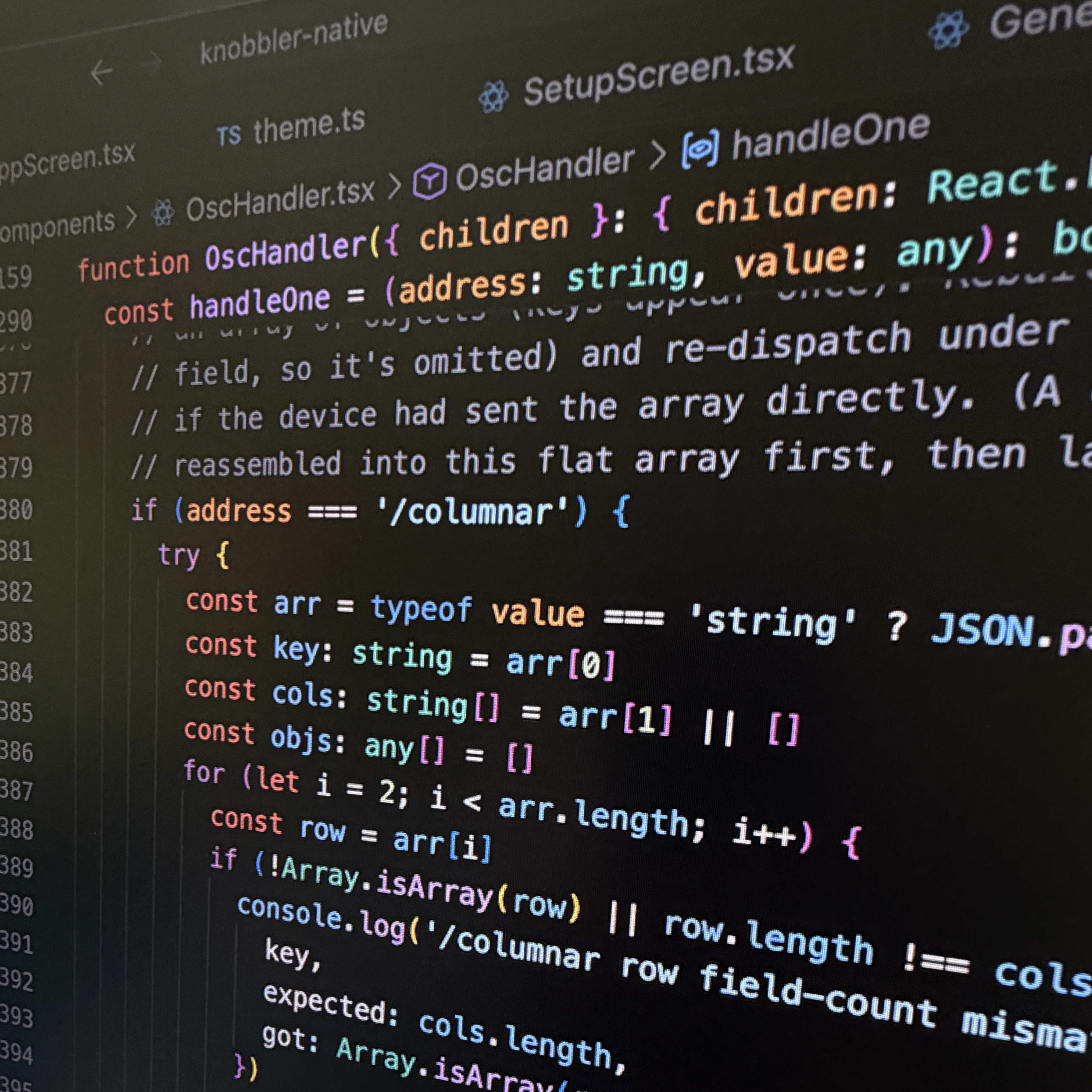
The savings scale with the record count and with how key-heavy the schema is. For the example above, the object form runs ~330 bytes; columnar lands near ~170 — roughly half. A 95-scene /clips/scenes list ({"n":…,"c":…} per scene) drops by a third. The more records, the closer you get to "keys paid once" instead of "keys paid N times."
And because I shaped the envelope as a flat array rather than a nested object, a large columnar payload still flows through the chunker from step 4 — so the two stack: shrink the structure, then split whatever's left. Fewer chunks also means fewer chances for a dropped piece to fail a checksum.
The part that makes it maintainable
Two things kept this from becoming a tangle:
- It's all in the send pipeline. Feature code calls
osc('/clips/update', cells). The pipeline detects an array of objects, columnarizes it, chunks it if it's still big, and emits. Decode is symmetric on the app side. No feature ever learned about any of this. - Every step is capability-negotiated. On connect, the app advertises what it understands (
batch,cNav,chunkAny,col, …). The device only uses an encoding the connected app can decode, and falls back gracefully otherwise. So a new device and an old app — or vice versa — still talk; they just talk plainer.
So, five distinct kinds of waste leading to five chained solutions: too many packets for one value, too many packets for many values, payloads too big for a packet, and schemas repeated per record. None of it changed what Knobbler does — it just made the firehose fit comfortably through the pipe, transparently and reliably.