Knobbler, the Max Symbol Table, and a Migration to v8
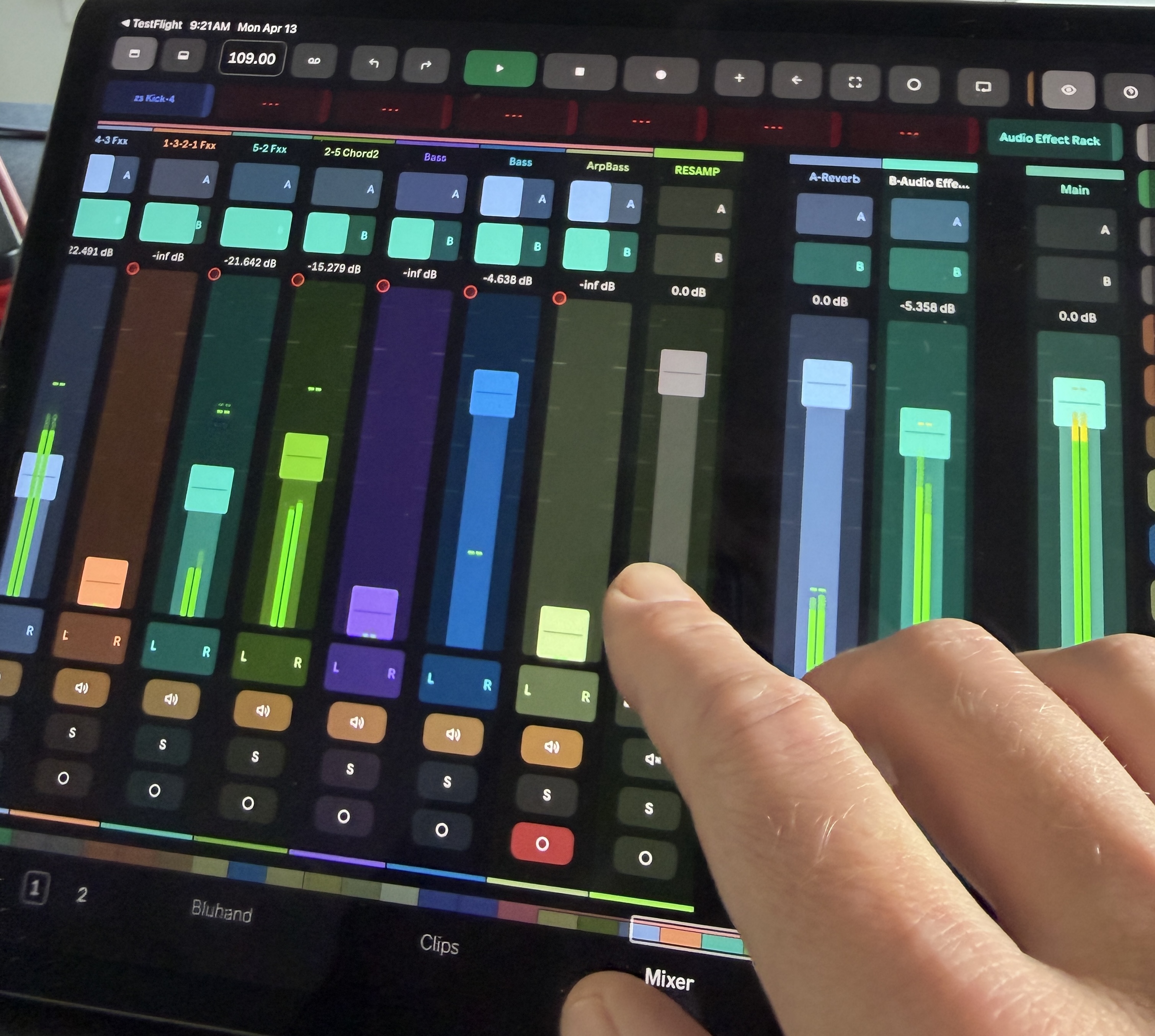
Knobbler is the Max for Live device I've been developing for several years. It pairs with the Knobbler companion app on iPad, iPhone, or Android to turn the touchscreen into an auto-labeling, auto-coloring, multitouch control surface for Ableton Live. Under the hood there's about 5,000 lines of TypeScript that compiles to JavaScript and runs inside Max's [js] JavaScript engine. It sends and receives a fair amount of network traffic — meter levels alone can update 30 times a second per visible track.
Performance has always mattered. I'd done a round of benchmarking earlier this year comparing Max's older [js] engine to the newer [v8] engine, which uses Google's V8 (the same JavaScript engine that runs in Chrome and Node.js). [js] is built on Mozilla's SpiderMonkey 1.8.5, which shipped with Firefox 4 back in 2011 — it tops out around ES5, so no let/const, no arrow functions, no class, no modern standard library. Writing TypeScript that compiles down to something that 15-year-old engine will accept is its own special adventure. The results were puzzling. [v8] came out 3-4x slower than [js] on basically every operation that touched the LiveAPI or the outlet bridge. The only thing it was faster at was pure JavaScript computation, where its modern JIT compiler ate [js]'s lunch.
That didn't sit right. V8 is famously fast. Why would the actual hot path of a Max for Live device get slower?
I tabled the question and shipped the benchmarks as-is. The optimistic note in my notebook said something like "v8 has Task memory leak issues anyway — wait for Max 9.1." So I waited.
The benchmark that made no sense
Months later, I came back to it. I wanted to revisit the dream of moving to v8 for the modern JS features and better garbage collection. I floated the puzzle past Philip Meyer, an absolute ace Max and M4L developer. He was as surprised as me and said: Joshua needs to see this. I sat on it for a while, then was on a hike with my friend David (who has has a little something to do with Max ;) and mentioned the performance surprise. He said "oh Joshua would be very interested in this!" So a couple weeks later I finally worked through my to-do list and emailed Joshua, who works on JavaScript at Cycling '74 (the makers of Max), with the harness code and asked what he thought was going on.
He came back within a day. He'd run the benchmark himself, in the opposite order — [v8] first, then [js]. The results flipped. [v8] was now 2x faster than [js], not 3-4x slower. The only difference was which engine ran first.
What?!?!?!
Then he explained why. My benchmark was specifically polluting Max's global symbol table. And this happens regardless of which JS engine you use — it's a Max-level thing, not a v8-vs-js thing. Whichever engine ran second was paying the inflated cost of looking up symbols in a hash table that the first run had bloated.
What the symbol table actually is
Max has a global hash table of interned strings called the symbol table. Every time a [js] or [v8] script does something like:
outlet(0, ['/mixer/meters', '[0.12,0.45,...]'])…the strings /mixer/meters and [0.12,0.45,...] get interned — converted into permanent entries in this hash table — before they can be sent as Max atoms. Interning is deduplicating: the first time Max sees a given string it adds an entry, and every later occurrence of that same string reuses it. So /mixer/meters only ever takes one slot no matter how often you send it. The problem is distinct strings — every new, never-seen-before string adds a permanent entry. The table is process-wide, never garbage collected, and lives for the life of Max.
Symbols aren't just a string-deduplication mechanism. They're also how Max's [send]/[receive] system works internally. So every property name, every message selector, every patch object's scripting name is in there too. It's load-bearing infrastructure.
Joshua's specific diagnosis cut even deeper:
If the strings that are turned into symbols hash to the same value because they have the same prefix, then there will be collisions that then compare the strings to see if a new symbol needs to be generated. So in general, it's not good form to create lots of symbols with the same prefix.
The hash function Max uses is computed from the first 16 characters of the string. So if you keep emitting distinct strings that share an identical 16-character prefix, they all hash to the same bucket. Each lookup then has to walk a longer linked list — string-comparing every entry — before it finds a match or decides to make a new one. The entire Max environment slowly gets slower.
And that's exactly the shape of the JSON payloads my device was sending: a fixed structural prefix (object braces, the same first key name, etc.) followed by varying numeric content well past the 16th character. Every payload hashed to the same bucket and that single bucket grew by tens of thousands of entries per hour — turning a constant-time hash lookup into a linear scan over a list that never stopped growing.
The net result? The Max environment got slower and slower the longer Knobbler ran.
Not good!
Testing what actually bloats
First I needed a way to see the table. Turns out Max will tell you: send the message ; max size (the leading semicolon makes it a global send to the max object) and Max prints the current symbol count to the Max window.
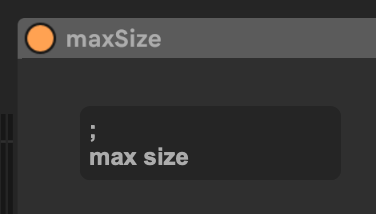
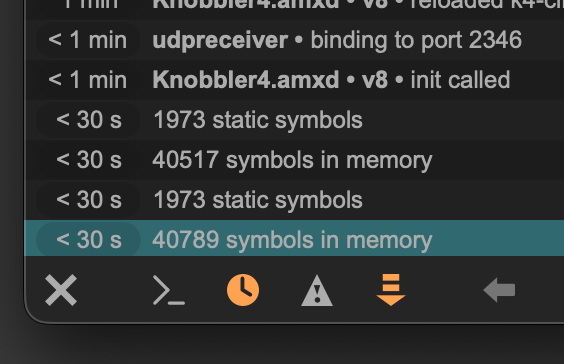
After a clean launch I'd see something like 1973 static symbols and 40789 symbols in memory. Run a suspect code path, send ; max size again, and any growth in that second number is symbols the path leaked into the table.
With that I wrote a small test harness that does three things:
- prep — pre-create 200,000 shared-prefix symbols (
sym_0throughsym_199999) and intern them. - bench — outlet those same 200,000 symbols and time how long it takes. After a clean Max launch this is the baseline.
- stress — exercise some candidate code path that might leak symbols. Then run bench again. If the second bench is slower, the stress polluted the table.
Each test needed a fresh Live launch to reset the symbol table. The results came out crystal clear:
| What the stress did | Bench time before | Bench time after | Verdict |
|---|---|---|---|
outlet([addr, freshString]) × 50k | 91ms | 103ms | Bloats (+13%) |
outlet([addr, freshString]) × 500k from [v8] | 91ms | 301ms | Bloats (+230%) |
outlet([addr, new String(s)]) × 500k from [v8] | 91ms | 89ms | No bloat |
dict.set(fixedKey, freshString) × 50k | 100ms | 100ms | No bloat |
dict.set(freshKey, fixedVal) × 50k | 91ms | 98ms | Bloats (+8%, mild) |
Two findings stood out.
Max Dict values don't intern. I had wondered about this — Dicts have existed since Max 6, predating the modern t_string atom type. Their internal string storage could have used regular symbols, in which case writing high-cardinality strings into a Dict would just move the leak. It doesn't. Dict values are safe.
[v8]'s new String(...) doesn't intern either. Wrapping a JS string in new String(...) makes [v8] emit a t_string atom instead of t_symbol. Same string contents, different atom type, no gensym call, no bloat.
Both of those findings pointed at clean architectures for fixing the leak.
A wrong turn, then the right turn
My first design leaned on both of those findings at once. Dict values don't intern, and [v8]'s new String(...) produces a t_string atom that also doesn't intern — so I'd use the Dict to carry native JavaScript data structures between modules, and a [v8] sender to do the final hop to [udpsend]. Concretely: each Knobbler module (still on [js] at this point) would write its payload object to a shared per-instance Dict keyed by OSC address, then emit a tiny fixed control message saying "hey, Dict has data for /mixer/meters, please ship it." A separate [v8] adapter would read that Dict entry, JSON.stringify it, wrap the result in new String(...) so the atom going out was a t_string, and feed it to [udpsend], the Max object that puts OSC bytes onto UDP. No symbol-table hit anywhere along the way.
Beautiful. I built it. I turned it on, and Live filled the console with:
udpsend: OpenSoundControl: unrecognized argument typeudpsend: osc unrecognized argument typeudpsend: OpenSoundControl: unrecognized argument type... (hundreds more)Turns out [udpsend]'s OSC packer doesn't know how to encode t_string atoms. It knows symbols. It doesn't know strings. The new String(...) trick is symbol-safe at the JS side but breaks the rest of the pipeline.
Tempting workaround: convert the String back to a symbol just before handing it to [udpsend]. There are objects in Max that'll happily do that. But the moment you do, you've reinvented the leak — every unique string gets gensym'd on the way through, and the symbol table fills up just as fast as it did before. The problem just moved one hop down the chain.
(Rumor has it that Max 9.2's [udpsend] will handle t_string atoms natively, which would make the new String(...) path a one-line fix. But Max 9.2 isn't shipped yet, and I needed something that works in Live today.)
So close.
rawbytes to the rescue
[udpsend] in Max 9 has a rawbytes message that takes a list of byte values — each byte arrives as an integer atom — and ships them as a UDP packet, completely bypassing its OSC formatter. That's the key: as established earlier, numeric atoms are never interned. So if I build the OSC packet bytes myself in JavaScript and hand [udpsend] that list of integers, the variable-content payload moves through Max as numbers, touches no symbols, and never grows the table by a single entry.
OSC binary format is pretty simple: a null-terminated address string padded to 4 bytes, a comma-prefixed type tag string padded the same way, then the args (32-bit big-endian for ints and floats, padded strings for strings). About 50 lines of TypeScript to build the packet.
With the Dict design dead, there was no longer a reason to keep half the codebase on [js] and half on [v8] — so I made the call to migrate everything to [v8]. (Ableton Live 12.4 ships Max 9.1.4, which fixes the v8 memory leak issues that had been blocking me.) Every module could now build its own OSC packet bytes and hand them directly to [udpsend], no intermediary needed.
The final architecture ended up cleaner than the original design. There's a single helper osc(addr, value) that everything goes through:
export function osc(addr: string, val: any) { if (typeof val === 'number') { // Numeric args are symbol-safe via udpsend's normal path outlet(OUTLET_OSC, [addr, val]) return } // Strings, objects, arrays — build the packet bytes and send rawbytes const bytes = buildOscPacket(addr, val) outlet(OUTLET_OSC, ['rawbytes', ...bytes])}Numeric values take the fast path with no overhead — Max never interns numeric atoms, so they can't touch the symbol table no matter how many you send. Anything else gets packaged as raw OSC bytes and skips Max's atom system entirely. The wire format on the network is identical to what [udpsend] would have produced — the receiving app didn't have to change a thing.
The migration gotchas
Moving 11 JavaScript modules from [js] to [v8] surfaced a small parade of latent bugs that [js] had been forgiving about. If you're considering the same migration, watch for these:
[v8] is stricter about types at the LiveAPI boundary. LiveAPI.id's setter requires an integer. [js] happily accepted the strings that LiveAPI.get(...) returns and converted them implicitly. [v8] doesn't. I had a utility function whose declared return type said number[] but was actually returning string[] — [js] had been tolerating the lie for years. The fix cascaded automatically to dozens of call sites once I made the function honest.
LiveAPI observer args come in the documented order. A property observer's callback receives [propertyName, value]. That's what [v8] delivers. [js] delivered them reversed — [value, propertyName] — and code in my codebase had quietly grown up around the wrong order. One specific case: my sidebar mixer's track-change handler was checking the wrong array index, so the strip silently stopped updating on every track switch.
refresh is reserved. Several modules had a function refresh() invoked via a Max message from the patcher. Under [js] this worked fine. Under [v8], the message never reaches user code. Max intercepts refresh before dispatch — even an anything() catch-all doesn't see it. Cost me hours. The fix: rename refresh to anything else.
The aftermath
I shipped it. The new Knobbler4 device is now 100% [v8], top to bottom — no more split brain, no more [js] modules quietly poisoning the symbol table in the background.
The symbol table stays flat. Performance is better than it's ever been — the modern V8 JIT handles the pure-JavaScript work my modules do, and the rawbytes pipeline means none of the high-cardinality network traffic ever touches a symbol again. Best of all, the thing that started this whole investigation is gone: long sessions in Live no longer start to feel laggy. The environment stays as snappy at hour three as it was at minute one.
I can't wait for people to experience it.
What it taught me
Going in, I thought I was investigating a minor performance question. Coming out, I'd touched almost every module in the codebase and learned a stack of things I hadn't known:
- Max has a global symbol table whose performance characteristics affect everything in the Max environment, not just my device.
- That table's hash function is sensitive to shared string prefixes in a way that punishes high-cardinality structured data like JSON.
- The fix isn't avoiding strings — it's avoiding interning them. Either don't make them into Max atoms at all (rawbytes), or use atom types that don't intern (
t_string, but only if the receiver knows what to do with it). - The newer
[v8]engine isn't a drop-in replacement for[js]. It's stricter about types, dispatches messages slightly differently, reserves some message names, and exposes behavior that[js]was quietly papering over. - Reaching out to experts is almost always worth it. Joshua's two-sentence email saved me weeks of guessing. (See also: the trail work post and Troy.)
A new friend or two at Cycling '74. A test harness I can run again any time. A symbol-safe outbound OSC pipeline I can trust. And the warm feeling of finally understanding why my benchmarks were lying to me a year ago.
Not bad for a debugging session that started with "wait, why is [v8] slower?"